

If you own a retirement account and you are over 70 1/2 you have to take minimum distributions referred to as RMDs. The amount you need to withdraw is based on IRS formulas that are presented in RMD tables. So those tables tell you exactly what your RMD must be. These are not hard to understand and it’s crucial that you do. Why? For two reasons.
First, if you don’t take out enough from your retirement account, you’ll face a 50% penalty. That smarts Pilgrim. The second reason you need to understand this is because your custodian may not. Your custodian is the company that holds on to your IRA for you and they are supposed to calculate your RMD for you. But my experience over the last 30 years tells me they don’t fully get it. I’ve seen too many mistakes that have cost too many people way too much money. As a result, I double check every required minimum distribution and so should you.
The first step is to understand what an RMD is. The term “RMD” stands for Required Minimum Distribution as I said above. This is the amount you must withdraw from your retirement account. The amount depends on your age and the kind of retirement account we’re talking about. Using this information you can look up your factor from IRS Publication 59 using the RMD tables.
What is a “factor”?
Your factor is the number you divide your account value by in order to determine your RMD. So if your factor was 25 and you had $100,000 in the account as of December 31st of the following year, your divide $100,000 by 25 and calculate that you must withdraw $4000 this year in order to satisfy the IRS kids.
Using the tables.
For purposes of this post, I’m going to look at a regular IRA and a Beneficiary IRA account to demonstrate how to use those tables.
Here’s the table you would use for any IRA account other than a beneficiary IRA:

You can see that if you are 70, your factor is 27.4 and if you are 80 your factor is 18.7. Let’s assume you have an IRA with a balance of $100,000 as of 12/31 last year. So let’s apply what we learned above in another example.
If you are 70 1/2, you take your $100,000 and divide it by your factor of 27.4 to arrive at $3649. This is your RMD for the current year.
If you are 80 and have a $100,000 use the factor of 18.7. In that case, you’ll get an RMD of $5347 if you divide your balance of $100,000 by the factor of 18.7.
You can see that as you age the required minimum distribution rises. That’s because the government wants you to take all the amount of your IRA before you pass away so they can tax you on it. Greedy.
How the IRS Calculates Your Age and Why It Matters
Let’s say you turn 70 ½ in January this year. That means you are going to turn 71 by July. So when you calculate the RMD, which age do you use? 70 or 71? The answer is that the IRS wants you to use the RMD tables based on your age at the end of the year. So in this case, you’d use 71 to look up your factor on the RMD tables. It’s pretty straight forward – if you know what the IRS is looking for.
How to use the RMD Tables for Beneficiary (Inherited IRA) Accounts
Here’s the table the IRS provides:
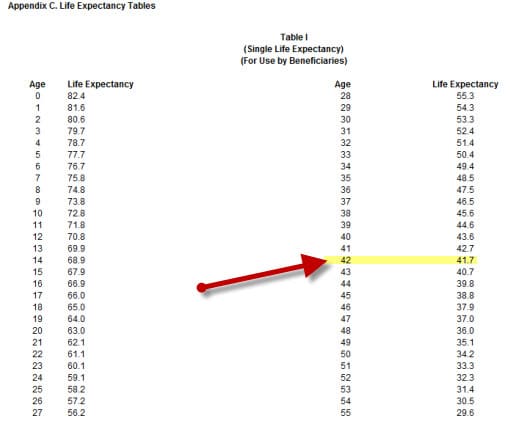
Beneficiary IRA RMDs are calculated far differently. You are required to start taking RMD’s in the year following the death of the owner of the account. So to calculate your RMD here’s the best way to run the calculation.
- Take the year the owner died
- Add one
- Subtract the year you were born. That is how old you were when you were required to start taking your Inherited IRA RMD.
- Look up your factor.
So if you were born in 1970 and you inherited an IRA in 2011 here’s what it looks like.
2011 + 1 – 1970 = 42.
So you turned 42 in 2012. Using the table above, your factor is 41.7. If the value of the account was $100,000 on 12-31-11, your RMD is $100,000/41.7 or $2398. Notice that there is no “70 1/2 rule” for Inherited IRAs. Sorry Charlie.
In the following years, you simple subtract 1 from the original factor to determine your divisor. So by 2022 your factor will be 31.7. Make sense?
As I said, this is different from the calculation for “normal” RMD’s. For regular retirement plans, you have to consult the table every year. For Inherited IRAs, you don’t have to consult the table after you calculate what your first factor was.
Using the RMD tables is pretty easy if you simply understand how the IRS views your age. You’d think that your IRA custodians would be able to do this calculation but trust me, they can’t. Fortunately for you, it’s easy to do this yourself and confirm that the RMD your custodian tells you to withdraw is the correct amount.
Do you confirm the RMD your custodian and/or CPA calculates for you? What have you found?
User Generated Content (UGC) Disclosure: Please note that the opinions of the commenters are not necessarily the opinions of this site.